
Academic Foundation Review
Overview
Before you begin learning about Workday Student Financials, you need to have a solid understanding of academic foundation features and concepts. This foundation determines the structure of your institution within Workday, as well as ownership and access to data elements within that structure. In this chapter, you will review the concepts of the academic foundation and observe the configurations in your tenant. You will also create an academic unit policy.
Note
: The Global Navigation Menu button, located in the upper-left corner of the screen, is also referred to as the Menu button throughout this course.Objectives
By the end of this chapter, you will be able to:
- Explain and configure academic units and levels.
- Define academic policies.
- Describe the student financials period record.
Academic Foundation
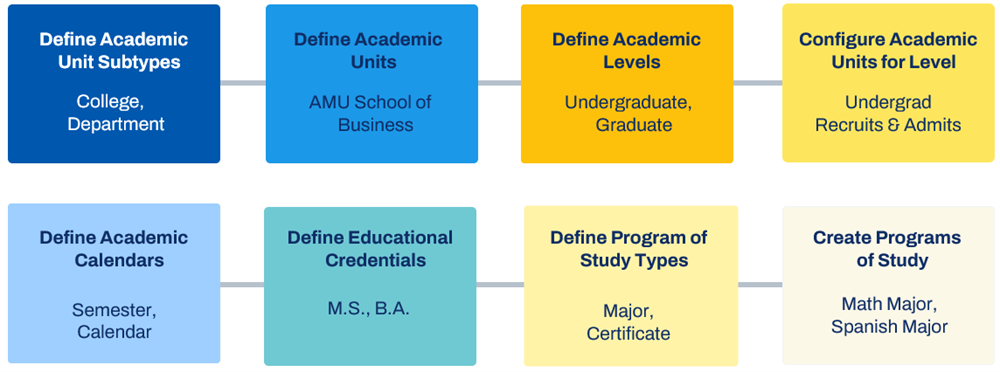
Academic structures are built from several components. As you build each piece, you combine them into a hierarchical structure that represents your institution. To define your academic foundation, configure the following:
- Academic Units
- Academic Unit Subtypes
- Academic Levels
- Academic Calendars
- Academic Periods
- Academic Years
- Program of Study Types
- Programs of Study
- Educational Credentials
The following image outlines the components that make up an academic structure.
Academic Units
Academic units are the foundation of Workday Student. They represent the colleges, schools, departments, and other units of your institution, such as School of Medicine or English department. Academic units drive ownership and access to data within your institution. Use academic units to:
- Assign appointments.
- Facilitate business process configuration and role assignments.
Specify which units can:
- Admit students
- Offer courses
- Offer programs of study
- Recruit students
Academic Unit Configuration Options
The following are brief descriptions of each of these configuration options.
Configuration Option | Description |
|---|---|
Admit Students | Used to create applicants and define admissions eligibility, requirements, assessments, and cohorts for a given academic level. |
Offer Courses | Used to offer courses for a given academic level. |
Offer Programs of Study | Used to create and offer programs of study for a given academic level. |
Recruit Students | Used to create student recruiting cycles, campaigns, events, and prospects for a given academic level. |
Academic Unit Subtypes
Use academic unit subtypes to classify your academic units. Examples include school, department, institute, center, or college. Define these subtypes to reflect the different organizations at your institution. You can then create academic units appropriate for your institution's academic unit structure.
Use the
Maintain Academic Unit Subtypes
task to edit or add academic subtypes. Access the View Academic Unit Subtypes
report to view a full list and the details of academic unit subtypes.Academic Unit Structure
After defining the academic unit subtypes your institution uses, you can build your institutional academic structure. When building the academic structure, start by creating the different academic units to represent each organization at your institution. After you create the academic units, you can connect each academic unit to a superior academic unit. These connections result in a single hierarchical structure that reflects your organization's actual academic structure.
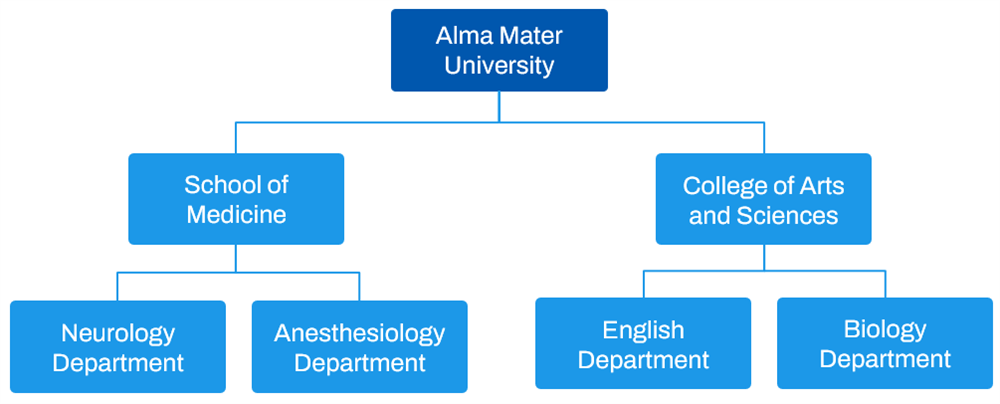
Each academic unit can contain one or more academic levels. Each of those levels can admit students, offer courses, offer programs of study, and recruit prospects. An academic unit inherits role assignments and business process definitions from its superior academic unit, if there is one. Additionally, depending on the setup, subordinate academic units can inherit level configurations from a superior academic unit.
If you wish to recruit students, admit students, and offer programs of study and courses, at a minimum, you must configure the highest academic unit.
You can assign workers to a specific role on an academic unit, such as a Student Recruiter or Student Admissions Reviewer. This role applies to that academic unit and any subordinate academic units.
Note
: For Workday Student, Workday recommends that you assign roles and configure business processes for the top-most superior academic unit. You can then modify business processes and directly assign roles for subordinate units where necessary.Touchpoint
: Workday also uses academic units for academic appointments in Workday Human Capital Management (Workday HCM) to track a person's academic career with your institution. Appointments could be for active, terminated, emeritus faculty, clinical faculty, contingent workers, or visiting academics. A faculty member may have more than one concurrent academic appointment. For example, a faculty member may have an appointment as a Professor in the Chemistry department and an appointment as Dean of the College of Arts and Sciences.Academic Unit Hierarchies
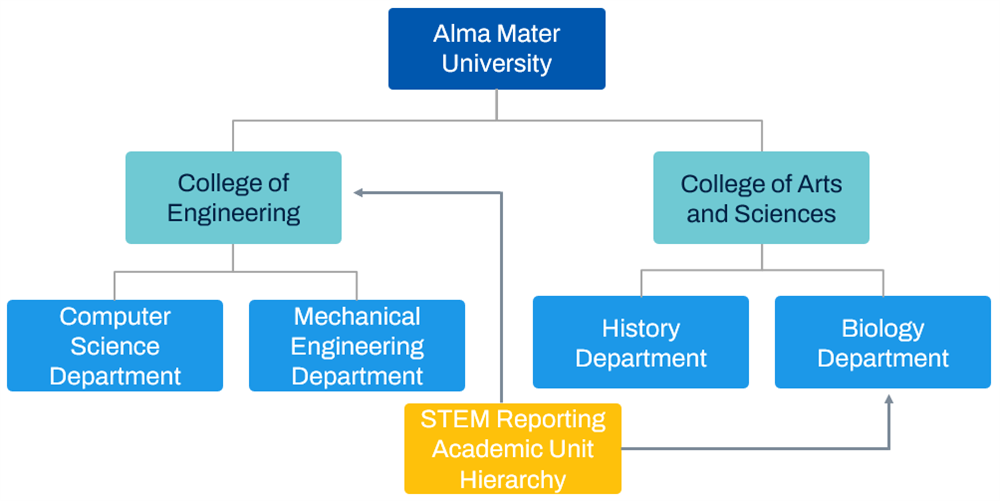
Academic Unit Hierarchies support rollup reporting. They also facilitate academic appointment business process configuration and role inheritance. Each Academic Unit Hierarchy can be a single node that is part of a larger hierarchy or tree. Once you design and build the tree, you can include individual academic units in the appropriate Academic Unit Hierarchy node.
You can include the same academic unit in more than one Academic Unit Hierarchy on different trees. However, if you use hierarchies for appointment-related business processes, you should create one main Academic Unit Hierarchy to manage these business process configurations. After establishing this main Academic Unit Hierarchy, assign roles to the hierarchy to route business process actions.
You can create additional Academic Unit Hierarchies by school or discipline for reporting purposes only. A multiple-hierarchy structure provides flexibility for rollup reporting. Ensure you assign only reporting roles to the additional hierarchies rather than roles that participate in business processes.
Academic Unit Hierarchies do not have directly assigned academic appointments. Instead, the system assigns appointments to the academic units within the hierarchies. You can use hierarchies to report on the academic appointments assigned to the units within the hierarchy structure.
Academic Unit Reorganization
If you need to reorganize your academic structure, Workday provides a framework for you to identify the objects preventing you from assigning a new superior academic unit and lists the conflicts in a report. The report listing the conflicts preventing reorganization helps in preventing organizational setup errors downstream.
Use the View Reorganization Conflicts button on the
Assign Superior Academic Unit
task that displays the new View Reorganization Conflicts for Academic Units
report.From the academic unit, you can access this task as a Related Action by selecting
Academic Unit > Assign Superior
. After you select a new superior academic unit, select the View Reorganization Conflicts button to view any conflicts that prevent you from assigning the new superior academic unit.Academic Levels
Academic levels are the level of an educational objective that a student can achieve at your institution. Examples include undergraduate, graduate, professional, or associate. Use the
Maintain Academic Levels
task to define the academic levels that your institution uses.Levels in Academic Structure
Each academic unit can have one or more academic levels associated with it. You can configure each level to:
- Admit students: Create applicants and define admissions eligibility, requirements, assessments, and groupings for the academic unit and level.
- Offer courses: Offer courses for that academic unit and level.
- Offer programs of study: Create programs of study for the academic unit and level.
- Recruit students: Create student recruiting cycles, campaigns, events, and prospects for the academic unit and level.
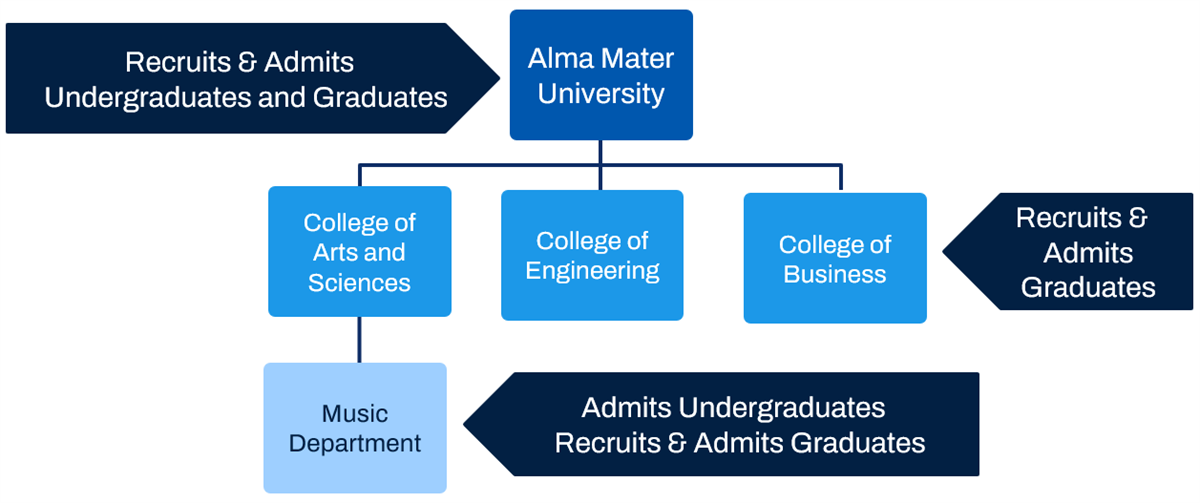
If you do not configure an academic unit for a level, the next superior academic unit with that configuration performs those functions. For example, in the following graphic, Alma Mater University did not configure the College of Arts and Sciences to admit undergraduate students. Therefore, the system assigns an undergraduate application to a department other than music to Alma Mater University as the next highest academic unit configured to admit undergraduates.
Academic Calendars, Periods, and Years
Academic periods are the fixed date ranges defined by your institution. These periods make up an academic year and typically consist of semesters or quarters. You can define these fixed periods down to a specific date. You can then associate these academic periods with an academic year. An academic calendar serves as a template that defines the standard format for an academic year, e.g., a semester containing a fall, spring, and summer period. The table below provides examples of how you can configure a semester or quarter academic calendar for an academic year.
Academic Calendar | Academic Year | Academic Periods |
|---|---|---|
Semester Academic Calendar | 2025 - 2026 Academic Year | 2025 Fall Semester 2026 Spring Semester 2026 Summer Session |
Quarter Academic Calendar | 2025 - 2026 Quarter Academic Year | 2025 Fall Quarter 2026 Winter Quarter 2026 Spring Quarter 2026 Summer Quarter |
Note
: You must assign a calendar to the program of study, academic unit, or a superior academic unit to be available for selection.To define your institution's date ranges, define, in order:
- Academic Period Types
- Academic Calendars
- Academic Years
- Academic Periods
Academic Calendar Policy
After defining the structural units of your institution's academic periods and years, use an academic calendar policy to associate a calendar structure to an academic unit and academic level combination or program of study. For each academic calendar policy you configure, identify the following details:
- Academic calendar (Semester calendar)
- Typical attendance pattern
- Student unit type (Units, Semester Units, Quarter Units)
- Starting academic year
You can change an academic calendar for a given academic unit and level combination or program of study using an academic year after the initial configuration.
Student Registration
Workday automatically creates the Student Financials Period Record (SFPR) when a student matriculates. The SFPR builds based on the primary program of study of the student's reporting record. It uses the primary program of study's anticipated start date and ends with the expected completion date.
Note
: SFPRs are not created for applicants.Programs of Study
Programs of study (POS) represent the educational objectives offered by your institution. For example, a POS could be a Biology major through which a student can achieve a Bachelor of Science degree or a Culinary Arts program that results in a certificate. Programs of study have wide-ranging implications across all of Workday Student. The programs your institution offers drive a student's academic experience and hopefully, results in a degree or credential.
Note
: When creating a Program of Study, you will need to identify the owning academic unit and the owning academic level. You can update the owning academic unit as long as the new academic unit has its own calendar policy. Access the Program of Study's Related Actions to edit.Program of Study Types
Program of study types classify the programs of study offered by your institution. They also control the configuration options available to programs of that type. You can configure a program of study type to standalone, grant credentials, and have concentrations, e.g., Certificate, Major, Non-Credit, or Program (often used at the graduate or professional level).
Use the
Maintain Program of Study Types
task to configure your programs of study types.Program of Study Type Categories
You can assign program of study types to one of the following Workday-provided categories:
Category | Available for Admission? | Program of Study Type Examples |
|---|---|---|
Advisory Program | No | Pre-Professional, Transfer |
Auxiliary Program | No | Minor, Cluster |
Formalized Joint Program | Yes | Dual Program, Joint Programs, Dual Degree |
Non-Degree Program | Yes | Non-Degree, Visiting Students |
Official Programs | Yes | Program, Major |
Program Focus | No | Concentrations, Specializations |
Undeclared Program | Yes | Undecided, Exploratory |
Program Focus
You can indicate if a program of study has a concentration or focus by selecting the Concentration Possible checkbox for a specific program of study type. When you create a new program of that type, indicate whether the specific program requires a program focus.
For example, if the Music Performance major has a Bass concentration, make sure the following configurations are in place:
- The Major program of study type must have the Concentration Possible checkbox selected.
- The Music Performance Major program of study definition must have the Program Focus Required checkbox selected.
You can create a new program of study for Bass, with a type of Program Concentration, and associate it with the Music Performance major.
Program of Study Codes
Creating a program of study requires identifying a program of study code. The code you select must be unique within your tenant. These user-defined codes can be numeric, alphabetic, or alphanumeric.
Educational Credentials
Educational credentials are the credentials a student at your institution receives upon completing a program of study, such as a Master of Arts or a Health Care certificate. Workday supports the following credential types:
- Award
- Badge
- Certificate
- Certification
- Degree
- Diploma
- License
- Licentiate
When creating a program of study, you can specify which educational credential or credentials, if any, the program confers upon completion. For example, a student with a Biology major may choose to pursue a Bachelor of Arts or Bachelor of Science degree.
You can configure the educational credentials used for entering external transcripts, student applications, and transcript eligibility rules. This enables you to print commencement bulletins, evaluate requirements, and generate reports with greater accuracy. You can also define the educational credential usage as internal or external, making it easier to maintain the educational credentials used by your institution.
Flexible Credentials
Workday enables you to configure whether programs of study can grant only a single credential. You can also specify the default and additional credentials available to confer on students when they complete their programs of study. You can configure policies that determine whether to confer credentials from a student's primary or stackable program or from all programs, including multiple credentials of the same type. This gives you more flexibility to meet your institutional policies around credentials, such as double majors with a single conferred credential or joint programs with multiple conferred credentials of the same type.
Program Areas
Program areas allow you to group programs of study that may belong to different academic units. For example, your institution may wish to group all science, technology, engineering, and mathematics (STEM) programs together. These programs may include programs in the College of Engineering and the College of Arts and Sciences.
Program Minimum Coursework
You can configure Program Minimum Coursework on the Program of Study directly on the definition using the
Create Program of Study
task. The Program Minimum Coursework field displays the default value inherited from the federal student aid program policy, if any. You can override the default value for a standalone program of study.You define this field so that a Financial Aid administrator knows the defined program length. Use this field to evaluate if a student is making satisfactory academic progress, so they can continue to get awards properly, within the right allowances, boundaries, and rules.
First and Last Entry Dates
A program of study's first entry date is the earliest date that students can matriculate into the program. Define this date when creating a new program, as it can affect your student recruiting, admissions, and records processes.
You can also optionally select a last entry date for a program of study. The last entry date indicates the last date that students can matriculate into the program. Selecting a last entry date is a common configuration for discontinued programs. This end date does not affect students currently enrolled in the program.
Program Duration
Programs of study must also have a program duration. You can specify a program duration in weeks, months, or years. The duration indicates the typical amount of time a student requires to complete the program of study. This duration then determines the attendance plan, which advisors use when academic planning and when calculating satisfactory academic progress (SAP) for financial aid.
Routing Programs of Study by Coordinating Academic Unit
You can route business processes related to student program of study transactions using the owning academic unit, the coordinating academic unit, or both. Routing business processes in this way helps ensure more granular and flexible routing of student program of study transactions and better compliance with your institutional policies.
When a student adds a program, changes their program, or removes their program of study, Workday routes according to the rules defined for their specific program instead of by the academic unit.
You can assign roles directly on a program of study. To do so, you must enable roles for the program of study via the
Maintain Assignable Roles
task. You can then assign roles on programs of study by selecting Roles > Assign Roles from the Related Actions menu of a program of study. You can also access these reports by selecting Roles from the Related Actions menu of a program of study.You can configure business processes on programs of study by selecting Business Process > Create, Copy, or Link Definition from the Related Actions menu of a program of study. This enables you to route these student transactions to the most appropriate approvers for a program of study. When you configure a business process on a program of study and its academic unit, Workday uses the business process definition on the academic unit as the default. To assign a higher priority to the business process definition on the program of study, set up the order of precedence on the
Maintain Precedence for Business Process Definition Selection
task.Workday delivers a Program of Study: Roles domain that you can use to secure access to viewing and assigning roles for programs of study. Workday also delivers a Roles - Program of Study allowed security group type that you can configure on these business processes:
- Add Program of Study Event
- Change Program of Study Event
- Remove Program of Study Event
When you or your students add, change, or remove programs, Workday creates separate events for each program along with its bundled programs. This ensures that the correct approvers or departments for a program receive the event. When an approver denies a change of the primary program, Workday denies all program changes grouped under this overall event.
Workday delivers the
Configure BP Policy for Program of Study Changes
task (secured to the Manage: Academic Records domain), enabling you to configure the usage of a Review Change Programs Task Wizard step on the Change Program of Study Event. You can configure this policy for an academic unit and level or a program of study.You can select these tasks and reports for the Review Change Programs Task Wizard step, enabling you to notify approvers of student program of study changes:
- Academic Progress
- Review Change Program of Study
- View Current Classes
- View Program Overview
- View Proposed Program of Study
- View Proposed Programs of Study
Addable and Stackable Programs
Many students pursue multiple programs of study during their academic careers. Students complete these programs either concurrently or in sequence. Common examples include:
- A student completing a Psychology major and a Literature minor at the same time.
- A student signing up for both Nursing and Pre-Medicine programs, completed one after another.
- A student double majoring in Computer Science and Electrical Engineering.
To account for these circumstances, you can indicate if programs are addable or stackable for another program.
Addable Programs
Addable programs are programs completed in the same time frame. By default, all new programs of study are addable to any other program of study in your system. This means that students can sign up for multiple programs of study and complete them within the same time frame. For example, this configuration makes it simple for students to sign up for a major and a minor program of study, which would both have the same expected program completion date.
Stackable Programs
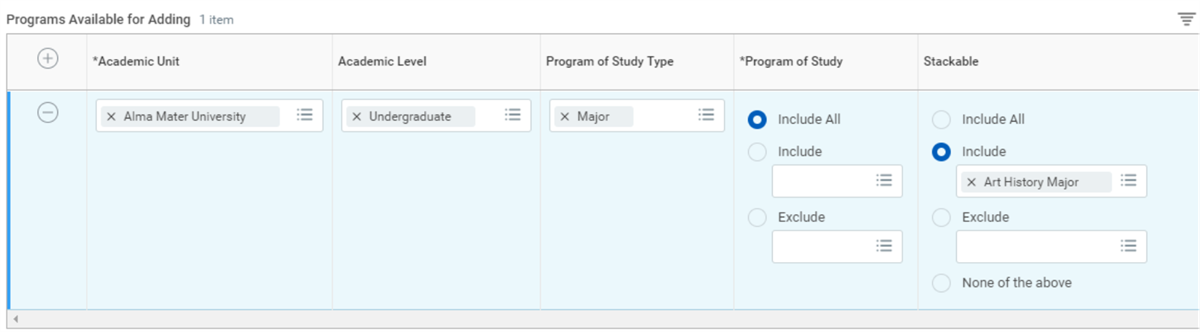
Some addable programs are also stackable, meaning that a student can complete them independently of any other program. Students can complete stackable programs before or after completing their primary program of study. For example, a student can begin coursework for a graduate-level Pre-Medicine degree while completing their undergraduate Nursing degree. You need to define a program of study as being stackable with another program. By default, the system does not automatically consider any programs stackable.
Academic Policies
In Workday Student, there are several key academic policies that you can configure for your individual academic units. These policies provide a flexible way to streamline processes for your institution. By setting up academic policies, you reduce manual effort and ensure consistency in student processes. The following are the common academic unit policies and their descriptions:
Academic Policy | Description |
|---|---|
Academic Standing Policy | Defines the rules to evaluate the academic standing of a student for an academic period. For example, define the grade requirements to identify students who meet minimum honors grade requirements. |
Calendar Policy | Defines the calendar, typical attendance pattern, and student unit type for an academic unit and level, or specific program of study, for a period of time. |
Class Standing Policy | Defines rules for Workday-delivered class standings, such as Freshman, Second Year, or 3L. Classifies students so that Workday can correctly process registration and financial aid. |
Course Attempt Limit Policy | Defines the number of times a student may attempt a course for credit. |
Course Repeat Policy | Determines if the last attempt or best attempt is used in course repeat processing. |
Course Unit Type Policy | Defines the default and allowed unit types for courses by academic unit and level. Workday uses this information in unit conversion. When the course unit type is different from the unit type of the program of study, Workday converts the units based on rules you set up. Workday provides support for course unit type policies across multiple academic units and institutions, by enabling you to specify the allowed and default unit types for an individual policy. |
Enrollment Access and Grading Policy | Defines which students can enroll in which courses, as well as the grading scheme used for the courses. |
Load Status Policy | Defines minimum units of credit or clock hours that constitute the Workday-delivered load status values, like part-time, or full-time. Used for institutional purposes, such as tuition calculation and enrollment verification, and also factors into financial aid eligibility. |
Payment Plan Policy | Enables students to pay for their tuition and other charges in installments over time, instead of upfront. These payment plans can be specific to an academic unit and level or program of study. |
Transfer Grade Mapping Policy | Determines how grades from external institutions map to the grades at your institution. Students are subject to the grade-mapping rules you assign to their academic unit and level or their program of study. |