
Reference: Operators and Functions for Conditional Formatting
Syntax Rules
Basic syntax:
first-expression comparison-operator second-expression
.
Example: ([Quick Ratio] - 10) * 2 >= 19
- An expression can reference any data series in the chart, including data from an account, calculation, or custom metric. You must enclose the data series name (not code) or the calculation name in brackets. Examples:[1000 Assets],[QuickRatio]. The data series name displays in Data Settings:
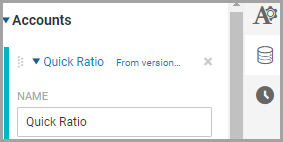
- Workday evaluatesexpressions left to right; expressions in parentheses calculate first.
Comparison
Operator | Description | Syntax |
|---|---|---|
= | Checks if two values are equal. | [metric1] =
[metric2] |
<> | Checks if two values are not equal. | [metric1] <>
[metric2] |
< | Checks if the left value is less than the right value. | [metric1] <
[metric2] |
<= | Checks if the left value is less than or equal to the right
value. | [metric1] <=
[metric2] |
> | Checks if the left value is greater than the right value. | [metric1] >
[metric2] |
>= | Checks if the left value is greater than or equal to the right
value. | [metric1] >=
[metric2] |
BETWEEN | Checks if a value is between two other values. Minimum and
maximum values are included in the range. Use with the
AND operator. | [metric1] BETWEEN 0
AND [metric2] |
NOT BETWEEN | Checks if a value is not between the two other values. Minimum
and maximum values are included in the range. Use with the
AND operator. | [metric1] NOT BETWEEN
0 AND [metric2] |
AND | Compares two expressions and returns true if both expressions are
true. | ([metric1] >=
[metric2]) AND ([metric1] >= [metric3]) |
OR | Compares two expressions and returns true if either expression is
true. | ([metric1] >=
[metric2]) OR ([metric1] >= [metric3]) |
Mathematical
Use mathematical operators with the expressions.
Operator | Description | Syntax |
|---|---|---|
+ | Adds two values. | [metric1] +
[metric2] |
- | Subtracts two values. | [metric1] -
[metric2] |
/ | Divides two values. | [metric1] /
[metric2] |
* | Multiplies two values. | [metric1] *
[metric2] |
% | Calculates the remainder (modulus) when dividing two
values. | [metric1] %
[metric2] |
^ | Raises the value on the left to the power of the value on the
right. For example, 5^ 2 = 25. | [metric1]
^2 |
Calculation Functions
Function | Description | Example |
|---|---|---|
min( expression ,
expression ) | Returns the smallest value of two expressions. | min([metric1],
[metric2]) |
max( expression ,
expression ) | Returns the largest value of two expressions. | max([metric1],
[metric2]) |
sin( expression ) | Returns the sine of a metric or expression. Used in
Trigonometry. | sin([metric1]) |
cos( expression ) | Returns the cosine of a metric or expression. Used in
Trigonometry. | cos([metric1]) |
tan( expression ) | Returns the tangent of a metric or expression. Used in
Trigonometry. | tan([metric1]) |
abs( expression ) | Returns the absolute value of a metric or expression. Use to
convert negative numbers to positive numbers. | abs([metric1]) |
sqrt( expression ) | Returns the square root of a metric or expression. | sqrt([metric1]) |
round( expression ) | Rounds a numeric value to the nearest whole number. The
mid-point is rounded up. Examples:
| round([metric1]) |
round( expression ,
digits ) | Rounds a numeric value to a specified number of digits.
Positive digits round to the specified number
of decimal places. Negative digits round to
the nearest multiple of 10. Examples:
| round([metric1],
1) |
floor( expression ) | Returns a numeric value rounded down towards zero.
Examples:
| floor([metric1],
2) |
floor( expression ,
expression ) | Returns a numeric value rounded down towards zero, to the
nearest multiple of significance. Examples:
| floor([metric1],
2) |
ceiling( expression ) | Returns number rounded up away from zero. Examples:
| ceiling([metric1]) |
ceiling( expression ,
expression ) | Returns number rounded up, away from zero, to the nearest
multiple of significance. Examples:
| ceiling([metric1],
2) |