
참조: 조건부 서식에 대한 연산자 및 함수
구문 규칙
기본 구문:
first-expression comparison-operator second-expression
.
예: ([Quick Ratio] - 10) * 2 >= 19
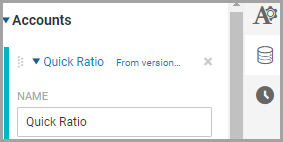
- 표현식은 계정의 데이터, 계산 또는 커스텀 메트릭을 포함하여 차트에 있는 임의의 데이터 계열을 참조할 수 있습니다. t를 묶어야 합니다.데이터 계열명(코드 아님) 또는 계산명 - 괄호 안. E예s:[1000 Assets],[QuickRatio]. T데이터 계열명 표시 in 데이터 설정:
- Workday 전자평가표현식왼쪽에서 오른쪽으로;표현식괄호 안 먼저 계산합니다.
비교
Operator | Description | Syntax |
|---|---|---|
= | Checks if two values are equal. | [metric1] =
[metric2] |
<> | Checks if two values are not equal. | [metric1] <>
[metric2] |
< | Checks if the left value is less than the right value. | [metric1] <
[metric2] |
<= | Checks if the left value is less than or equal to the right
value. | [metric1] <=
[metric2] |
> | Checks if the left value is greater than the right value. | [metric1] >
[metric2] |
>= | Checks if the left value is greater than or equal to the right
value. | [metric1] >=
[metric2] |
BETWEEN | Checks if a value is between two other values. Minimum and
maximum values are included in the range. Use with the
AND operator. | [metric1] BETWEEN 0
AND [metric2] |
NOT BETWEEN | Checks if a value is not between the two other values. Minimum
and maximum values are included in the range. Use with the
AND operator. | [metric1] NOT BETWEEN
0 AND [metric2] |
AND | Compares two expressions and returns true if both expressions are
true. | ([metric1] >=
[metric2]) AND ([metric1] >= [metric3]) |
OR | Compares two expressions and returns true if either expression is
true. | ([metric1] >=
[metric2]) OR ([metric1] >= [metric3]) |
수학
수학 연산자를 표현식과 함께 사용합니다.
Operator | Description | Syntax |
|---|---|---|
+ | Adds two values. | [metric1] +
[metric2] |
- | Subtracts two values. | [metric1] -
[metric2] |
/ | Divides two values. | [metric1] /
[metric2] |
* | Multiplies two values. | [metric1] *
[metric2] |
% | Calculates the remainder (modulus) when dividing two
values. | [metric1] %
[metric2] |
^ | Raises the value on the left to the power of the value on the
right. For example, 5^ 2 = 25. | [metric1]
^2 |
계산 함수
Function | Description | Example |
|---|---|---|
min( expression ,
expression ) | Returns the smallest value of two expressions. | min([metric1],
[metric2]) |
max( expression ,
expression ) | Returns the largest value of two expressions. | max([metric1],
[metric2]) |
sin( expression ) | Returns the sine of a metric or expression. Used in
Trigonometry. | sin([metric1]) |
cos( expression ) | Returns the cosine of a metric or expression. Used in
Trigonometry. | cos([metric1]) |
tan( expression ) | Returns the tangent of a metric or expression. Used in
Trigonometry. | tan([metric1]) |
abs( expression ) | Returns the absolute value of a metric or expression. Use to
convert negative numbers to positive numbers. | abs([metric1]) |
sqrt( expression ) | Returns the square root of a metric or expression. | sqrt([metric1]) |
round( expression ) | Rounds a numeric value to the nearest whole number. The
mid-point is rounded up. Examples:
| round([metric1]) |
round( expression ,
digits ) | Rounds a numeric value to a specified number of digits.
Positive digits round to the specified number
of decimal places. Negative digits round to
the nearest multiple of 10. Examples:
| round([metric1],
1) |
floor( expression ) | Returns a numeric value rounded down towards zero.
Examples:
| floor([metric1],
2) |
floor( expression ,
expression ) | Returns a numeric value rounded down towards zero, to the
nearest multiple of significance. Examples:
| floor([metric1],
2) |
ceiling( expression ) | Returns number rounded up away from zero. Examples:
| ceiling([metric1]) |
ceiling( expression ,
expression ) | Returns number rounded up, away from zero, to the nearest
multiple of significance. Examples:
| ceiling([metric1],
2) |